A Comprehensive Guide to Track Welding Equipment Essentials
Understanding Track Welding Equipment
What is Track Welding?
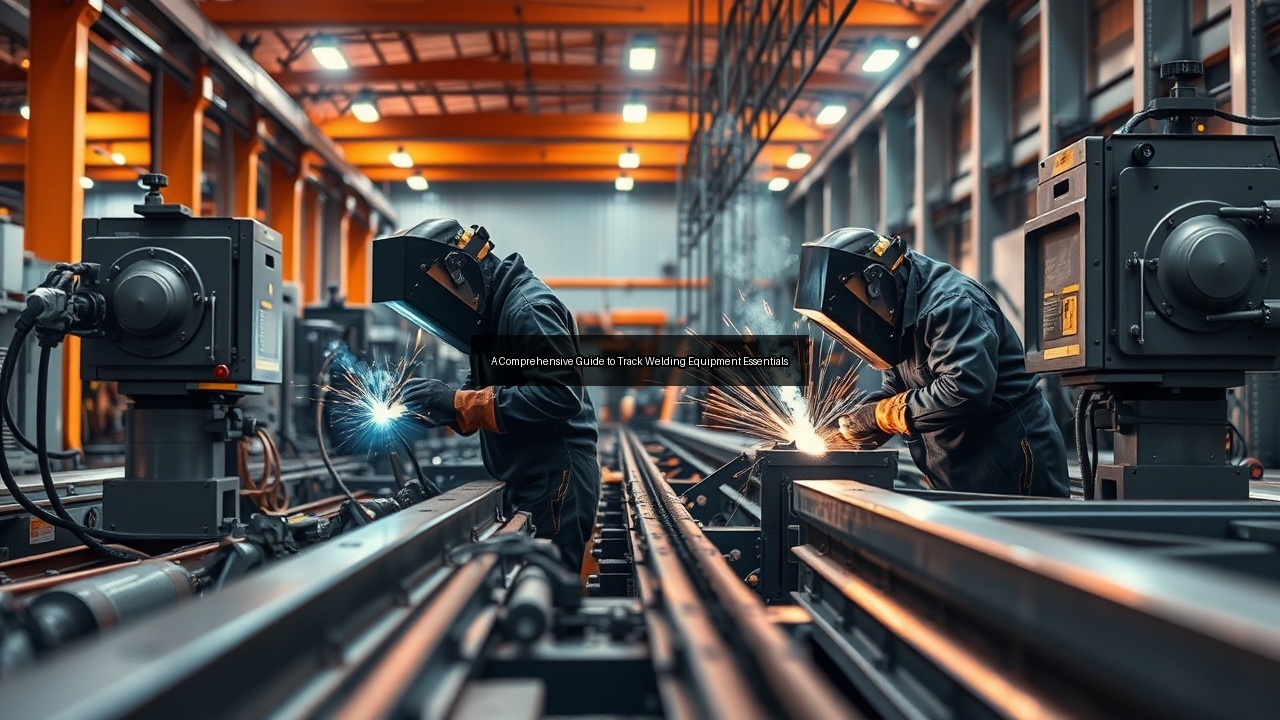
Track welding creates continuous, high-quality seams along linear or curved paths using guided machines that follow preset rails. Operators position a track welder on the workpiece to handle long joints in shipbuilding, pressure vessels, and structural fabrication. This approach delivers uniform penetration and bead appearance that manual methods struggle to match over extended distances. Track welding equipment reduces operator fatigue while maintaining precise travel speed and torch angle throughout the process. Fabricators choose track welding when projects demand repeatability across multiple identical sections or when access limits handheld torch control. The system supports both single-pass and multi-pass welds on thick plate without repositioning the entire setup repeatedly.
Key Components of Track Welding Machines
Every track welding machine relies on a sturdy rail or track system, a motorized carriage, and a welding head that holds the torch. The carriage travels along the rail at controlled speeds while an oscillator moves the torch side to side to widen the weld pool. Power sources supply consistent amperage, and wire feeders deliver filler metal at exact rates. Connecting rod assemblies link the carriage to the drive mechanism for smooth motion. Control panels allow operators to adjust voltage, travel speed, and oscillation width on the fly. These integrated parts work together to produce defect-free welds on carbon steel, stainless, and aluminum without constant manual adjustment.
Overview of Track Welders
Track welders come in portable and fixed configurations suited to different shop and field environments. Portable units clamp directly onto plates or pipes and travel under their own power, while larger systems mount on custom rails spanning entire hull sections. Modern track welders accept multiple processes including submerged arc, gas metal arc, and flux-cored arc welding. Manufacturers design these machines for quick rail alignment and simple torch changes so crews can switch between joint types without long downtime. Operators value the ability to program weld parameters once and repeat identical beads across dozens of seams, raising daily output while lowering rework rates.
Essential Equipment for Track Welding
Types of Welding Machines for Track Welding
Track welding machines range from compact DC power sources paired with carriage drives to full multi-process systems that include oscillators and seam trackers. Submerged arc units handle thick plate efficiently, while gas metal arc models suit thinner materials and out-of-position work. Some machines integrate dual torches for simultaneous welding on both sides of a joint. Fabricators match the machine for track welding to material thickness, joint configuration, and required deposition rate. High-amperage models support long continuous runs without overheating, and inverter-based units reduce weight for easier transport between job sites. Selecting the correct welding machine directly affects bead profile and productivity on every project.
Choosing the Right Electrode for Your Project
Electrode selection determines penetration, slag removal, and mechanical properties of the finished weld. Solid wire electrodes work well for clean plate under gas shielding, while flux-cored wires tolerate mill scale and provide higher deposition. Operators match electrode diameter to amperage range and joint thickness to avoid lack of fusion or excessive heat input. For track welding machines running long seams, consistent wire feed and stable arc characteristics prevent interruptions that create defects. Many crews test several electrodes on sample plates before committing to production runs. Proper storage and handling of electrodes also prevent moisture absorption that leads to porosity in the final weld.
The Role of Oscillators in Track Welding
An oscillator adds controlled side-to-side motion to the welding torch, widening the bead and improving sidewall fusion on wider joints. Track welding equipment often includes adjustable oscillators that vary frequency and amplitude to match groove width. This movement distributes heat evenly and reduces the risk of undercut along the toes. Operators fine-tune oscillation settings when welding dissimilar thicknesses or when using larger diameter electrodes. The feature proves especially valuable on flat or horizontal fillets where manual weaving would introduce inconsistency. Reliable oscillators maintain steady motion even during extended runs, supporting higher travel speeds without sacrificing weld quality.
Efficiency and Performance in Track Welding
Optimizing Your Welding Machine Setup
Proper setup starts with precise rail alignment and secure torch positioning relative to the joint. Operators verify travel speed, voltage, and wire feed rate against procedure specifications before starting production. Adjusting the connecting rod length ensures the carriage tracks smoothly without binding. Preheating plates to the correct temperature and maintaining interpass limits further improves results. Many crews run test beads on scrap to confirm parameters before committing to the actual workpiece. Consistent setup routines reduce start-stop events and let the track welder operate at peak efficiency across full shifts.
Understanding Oscillation and Its Impact on Weld Quality
Oscillation controls the width and shape of the weld bead by moving the torch laterally during travel. Proper oscillation settings increase sidewall fusion and reduce the chance of incomplete penetration at the root. Excessive amplitude can cause undercut or spatter, while insufficient motion leaves narrow beads prone to lack of fusion. Track welding machines with programmable oscillators let operators store recipes for different joint types and recall them instantly. This repeatability improves consistency across multiple welders and shifts. Monitoring the weld pool under oscillation reveals adjustments needed for varying fit-up gaps or material conditions.
Evaluating the Return on Investment for Track Welding Equipment
Return on investment calculations compare equipment cost against labor savings, reduced rework, and increased throughput. A single track welding machine often completes seams in half the time required by manual methods, freeing skilled welders for other tasks. Lower defect rates cut inspection and repair expenses. Fabricators also factor in the extended service life of quality machines when projecting long-term value. Many operations recover initial investment within the first year through higher daily output and fewer rejected parts. Tracking metrics such as arc-on time and inches of weld per shift provides clear data for future purchasing decisions.
Maintenance and Care for Track Welding Machines
Routine Maintenance Tips for Welders
Daily checks include inspecting rail surfaces for debris and verifying that drive wheels maintain proper tension. Operators clean wire feeders and contact tips to prevent feeding interruptions. Lubricating moving parts at recommended intervals keeps the carriage traveling smoothly. Checking electrical connections and ground clamps avoids voltage drops that affect arc stability. Recording maintenance activities helps identify wear patterns before they cause unplanned downtime. Following manufacturer schedules for oscillator and motor service extends the life of track welding equipment significantly.
Common Issues with Track Welding Machines and Solutions
Erratic travel speed often stems from dirty rails or worn drive components. Cleaning and replacing wheels restores consistent motion. Wire feeding problems usually trace back to incorrect tension settings or damaged liners. Adjusting or replacing these parts eliminates bird-nesting and arc instability. Oscillator malfunctions appear as irregular weave patterns and require calibration or motor replacement. Overheating power sources indicate blocked airflow or overloaded duty cycles. Addressing these issues promptly prevents larger failures and maintains weld quality on critical joints.
Importance of Using Quality Materials: Ceramic vs. Wire
High-quality ceramic backing materials provide stable support for root passes and produce clean, uniform beads without excessive grinding. Wire electrodes must match the base metal chemistry and deliver consistent diameter tolerances for reliable feeding. Lower-grade wire introduces variations in arc behavior and increases spatter. Ceramic options excel in applications where access limits full joint preparation, while premium wire supports higher deposition rates during fill passes. Combining both materials correctly on track welding machines yields stronger, more consistent results with less post-weld cleanup.
Future Trends in Track Welding Technology
Innovations from Gullco International
Gullco International continues to refine track welding equipment with improved carriage drives and digital controls. Their latest oscillators offer finer adjustment ranges and integration with seam-tracking sensors. Gullco machines now include data logging that records parameters for quality documentation. These advances help operators achieve higher productivity while meeting stricter code requirements. Fabricators using Gullco systems report fewer setup changes and more consistent results across long production runs. The company’s focus on modular designs also simplifies upgrades as new process technologies emerge.
The Impact of Automation on Track Welding
Automation adds seam tracking, adaptive parameter control, and remote monitoring to track welding machines. Sensors detect joint position deviations and adjust torch path automatically, reducing the need for constant operator attention. Integrated systems log every weld for traceability and allow supervisors to monitor multiple machines from a central station. Automation raises overall equipment effectiveness by minimizing human error and enabling continuous operation during shift changes. Shops adopting these features complete more linear footage per day while maintaining or improving weld integrity.
Sustainability in Track Welding Equipment
Modern track welding machines incorporate energy-efficient inverters that reduce power consumption during both active welding and idle periods. Manufacturers design components for longer service life and easier recycling at end of use. Reduced spatter and optimized deposition rates lower consumable waste. Some systems recover and reuse flux or shielding gas more effectively. These improvements cut operating costs and align with environmental goals without sacrificing weld quality or productivity. Operators increasingly evaluate sustainability metrics alongside traditional performance data when selecting new equipment.